Candidate: 20504984 (RA: 23.170898 Dec: 16.315388)
| Author | Message |
|---|---|
|
Near Time Persistency Checker Send message Joined: 8 Jul 09 Posts: 41 Credit: 0 RAC: 0 |
This is a discussion thread for SETI@home candidate # 20504984 (located at RA: 23.170898 Dec: 16.315388) Please feel to exchange thoughts, comments, questions and answers regarding this particular candidate. For more information, please read the NTPCkr Frequently Asked Questions (FAQ). ID: 927271 ·  |
 Johnney Guinness Johnney Guinness  Send message Joined: 11 Sep 06 Posts: 3093 Credit: 2,652,287 RAC: 0 
|
Matt Lebofsky, You might take a quick look at this one. This message is part of a discussion i was having with Donegal_TDI in the science forum here. ***************************************** Ok, so i plot 8 of the candidates in the current top 10 list using the RA and DEC for each candidate inside WWT(Microsoft WorldWide Telescope) and i take a screen-shot of each one as I'm going along. candidate numbers; 20582818 20582801 20504996 20493683 20499128 20504975 20496034 20504984 This is where the candidates are located in the sky; 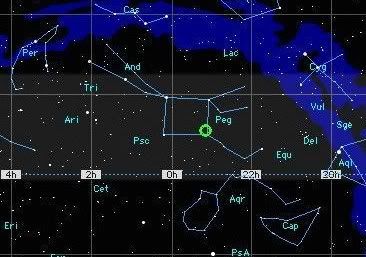 Here is a plot of those candidates; 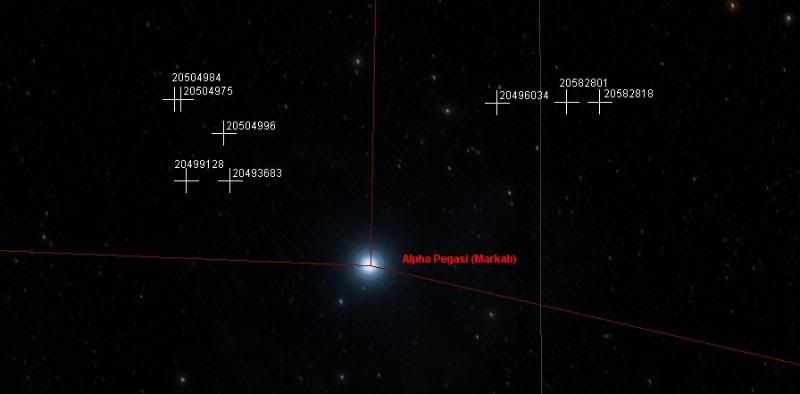 So then looking at the positions of the candidates, the three on the right hand side don't seem to have an obvious pattern or orbit. In fact none of the candidates seem to orbit Alpha Pegasi (Markab) at all! They look like they orbit something else! But the 5 candidates on the left of Alpha Pegasi (Markab), do appear to have a pattern. They look like they are orbiting something that i cannot see in the image? So i roughly plot what might be an orbital plain for these 5 candidates, its marked as a green ellipse in this next image; 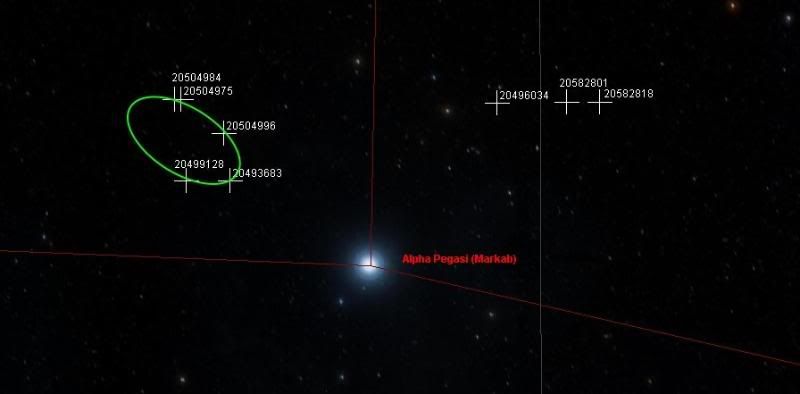 So far this seems to make sense. But in WWT, i am viewing the sky using the Digital Sky Survey (Optical). So i start searching for other telescopes that have surveyed the same part of the sky but in different wavelengths. So then i discover the "2MASS" sky survey (Two Micron All Sky Survey). Now the 2MASS survey shows many more objects that are not visible with other telescopes. So i take a screen shot of the same part of the sky around Alpha Pegasi (Markab), and i superimpose the image on top of the candidate plot i made. This is the result; 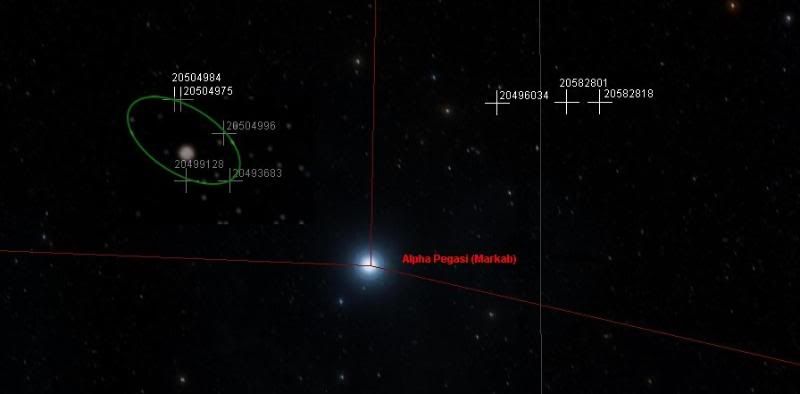 The 2MASS survey does show some type of star located almost in the middle of the orbital signal plot i made. Now look, i can't actually find any decent image of this unnamed star sitting to the upper left of Alpha Pegasi (Markab), so i really don't know what it is or what the name of the star is? but what i can say is that our 5 candidates appear to orbit something, and this unnamed star is in a position that looks quite close to the centre of the orbit. This is the best i can do to show a closer image of the star that our candidates look like they are orbiting; 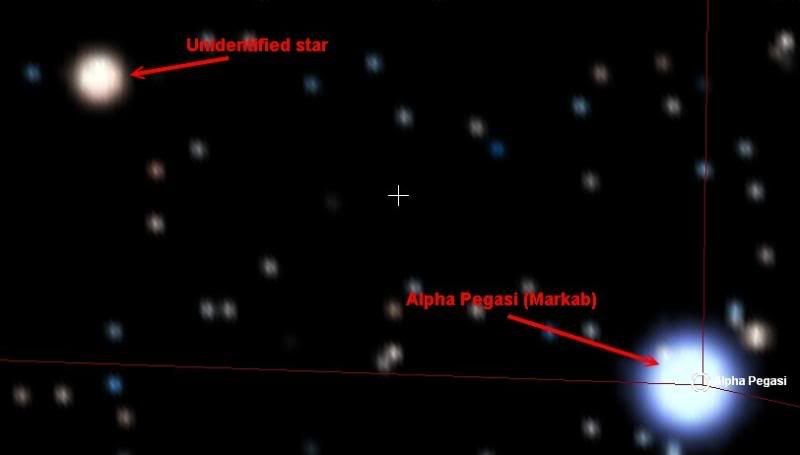 Here is a close-up screen shot of the unnamed star; 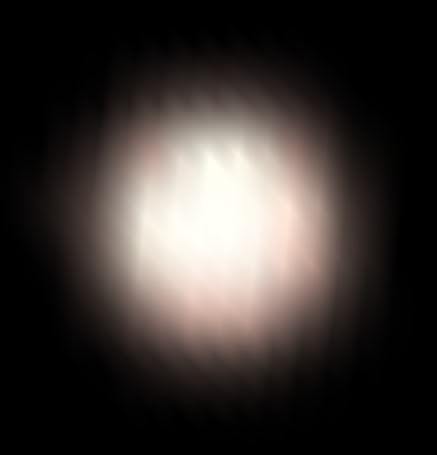 In my opinion, i do find this apparent orbital pattern for our candidates, and the unnamed star quite interesting. We could hypothesise and say that the candidates could be a radio source of some kind that might be on a planet orbiting the unnamed star. If it is a radio source on a planet, we are not going to be able to see the planet either way, we can only see the star. John. 
ID: 927793 · |
|
Johnney Guinness Send message Joined: 11 Sep 06 Posts: 3093 Credit: 2,652,287 RAC: 0
|
To further add to this message, i have a picture of the unnamed star mentioned in the previous post that our candidates appear to be orbiting. The cordinates of the star are; RA=23:09:52 DEC=15:49:32 Here is a link to the image of the star on the STSIC website. Unnamed star This is the image of the star; John. ID: 927819 · |
Misfit  Send message Joined: 21 Jun 01 Posts: 21804 Credit: 2,815,091 RAC: 0 
|
You could have a match if the distances to the star and candidates match up. But can SETI calculate the distance to a target with only 2 coordinates without taking a listen 6 months apart? me@rescam.org ID: 927824 · |
LXicon  Send message Joined: 13 Aug 09 Posts: 7 Credit: 2,077,450 RAC: 0 
|
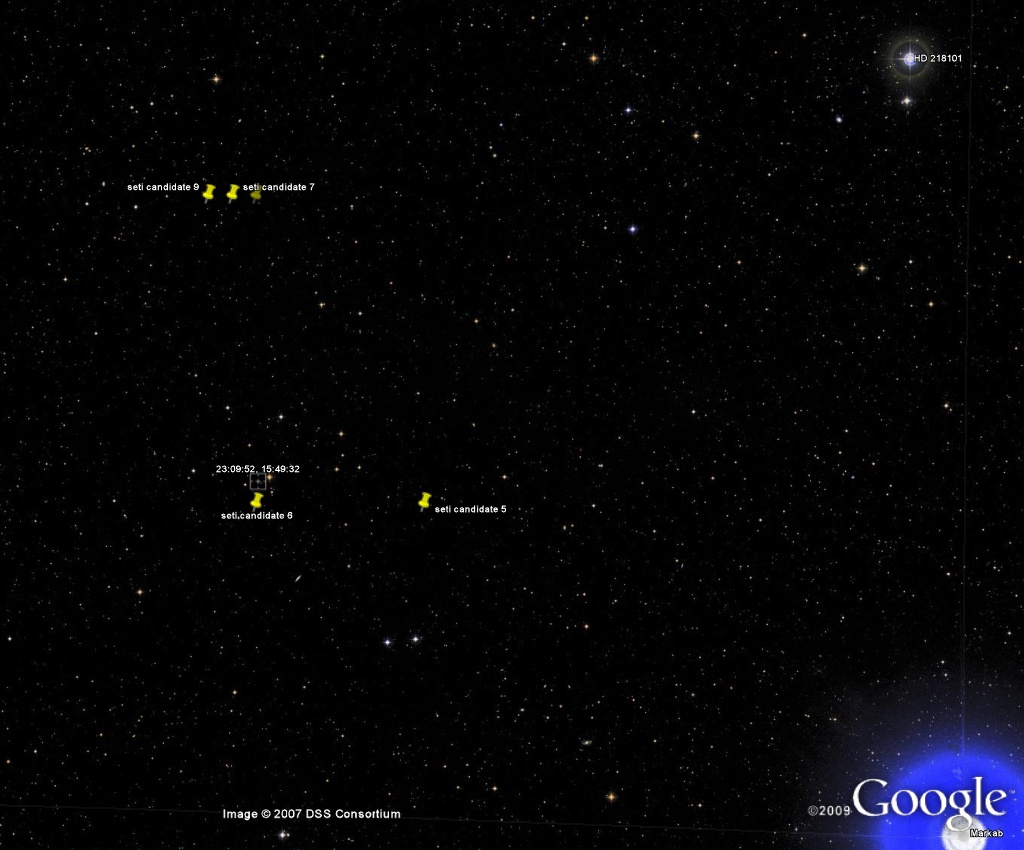
i see the same star around RA=23:09:52, DEC=15:49:32 it seems close to candidate 6 (ID 20499128 : http://setiathome.berkeley.edu/ntpckr.php?c=mcskyplot&id=20499128) here is a screen shot from google earth (sky) 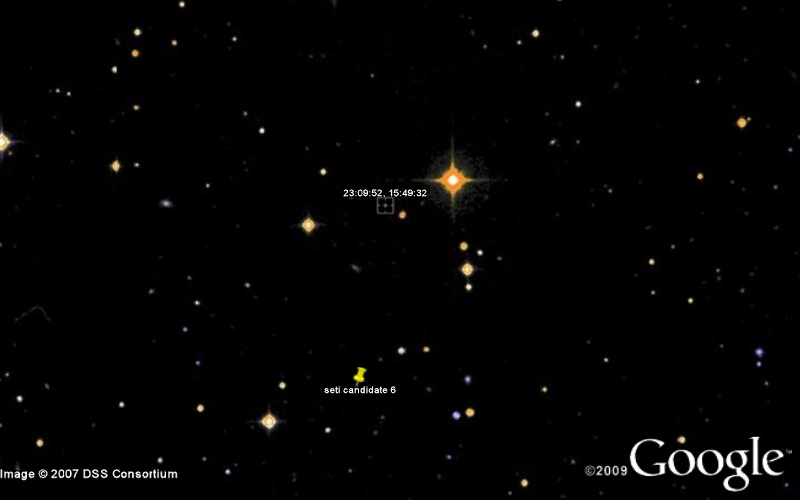 but it's not very close to the other candiates in that grouping. (i won't embed this image as it's 225K : http://www.lxicon.com/seti/candidates.4.5.6.7.9.2009-08-20.jpg ) i don't think the 5 candidates on the left of Alpha Pegasi (Markab) are orbiting something. they LOOK like they are close together, but the distances between them are probably very large. we don't know how far away from us these points are. i think the apparent spacial grouping of these candidates has more to do with the fact that the arecibo telescope is often "parked" when it's not doing specific observations. seti keeps collecting data regardless of where the telescope is pointing. seti will end up with more candidates in specific areas of the sky and those areas will have a greater chance of having candidates we see ion the top 10. ID: 927847 · |
Bill Walker  Send message Joined: 4 Sep 99 Posts: 3868 Credit: 2,697,267 RAC: 0
|
If we knew the distance to the unnamed star in the middle of this grouping, we could put a rough size on the minor and major axes of the ellipse plotted by John (assuming the ellipse is centred at that distance). That, plus the time between observations, could tell us something about a possible orbiting object. Going in another direction, I wonder how accurate and repeatable the RA and DEC are for the group of observations. Could this just be multiple observations of the same (non-orbiting) spot in the sky?  
ID: 927856 · |
|
Johnney Guinness Send message Joined: 11 Sep 06 Posts: 3093 Credit: 2,652,287 RAC: 0
|
I agree Bill, Look several people have now noticed the fact that 8 of the top 10 candidates are in one local area. And i have plotted 5 of these candidates and they look like they have a possible elliptical orbit around something. These are the 5 candidates i think might have an elliptical orbit; 20504996 20493683 20499128 20504975 20504984 As seen here; I have to admit, i cannot guarantee the accuracy of the way i plotted the candidates, i did it the best way i could, it should be pretty close. But i cannot say for sure that i have the coordinates of the star in the middle. The star sitting at RA=23:09:52, DEC=15:49:32 could possibly be in around the middle of the 5 candidates, but i cannot say this with any accuracy. I only have a small PC and i have pretty crappy graphics skills. To do this properly, we need a very large sky map of the area around Alpha Pegasi (Markab), with grid lines and markings. And we need someone with the ability to accurately plot these candidates. I could start again and plot them but i would end up with something similar. John.
ID: 927862 · |
|
Johnney Guinness Send message Joined: 11 Sep 06 Posts: 3093 Credit: 2,652,287 RAC: 0
|
Misfit wrote: You could have a match if the distances to the star and candidates match up. But can SETI calculate the distance to a target with only 2 coordinates without taking a listen 6 months apart? Misfit, You make a valid point! But i think that if we can see something, an object or a radio transmission source moving in the sky, that will usually mean that object or radio source is close to us in astronomical terms. We see planets in our solar system moving across the sky because they are close to us. Likewise, if a radio source on another planet is close to us, it would appear to move around in the sky in a kind of orbit around its own star. This is what i am suggesting might be happening in the plot i made. Maybe, because we can see the radio source moving in an orbit, maybe its on a planet orbiting another star that is close to us. John.
ID: 927871 · |
|
Misfit Send message Joined: 21 Jun 01 Posts: 21804 Credit: 2,815,091 RAC: 0
|
i don't think the 5 candidates on the left of Alpha Pegasi (Markab) are orbiting something. they LOOK like they are close together, but the distances between them are probably very large. we don't know how far away from us these points are. Just as 2 galaxies may look like they are right next to each other from our perspective one may be millions of light years behind the other. Swing out 90 degrees and the view may could dramatically change. Which brings up an interesting point. If SETI thinks they found an ETI signal the first question will be from where. If they don't have the necessary 3 coordinates all they can do is point in 'that direction'. me@rescam.org ID: 927923 · |
|
Gundolf Jahn Send message Joined: 19 Sep 00 Posts: 3184 Credit: 446,358 RAC: 0 
|
Maybe, because we can see the radio source moving in an orbit, maybe its on a planet orbiting another star that is close to us. I think we can't see something moving, just several different objects that happen to be on an ellipsis - from our point of view. If it were a planet, we should be able to see the star it's orbiting with normal telescopes. Can you imagine the diameter of the orbit you outlined, even if it were in the proximity of Alpha Pegasi - and the resulting time of circulation? Gruß, Gundolf ID: 927949 · |
|
Johnney Guinness Send message Joined: 11 Sep 06 Posts: 3093 Credit: 2,652,287 RAC: 0
|
***Important Notice!*** Today, i went back and rechecked my plots, and i think its important that i admit that i made a mistake in my original plot! And i apologise for this! When i rechecked the RA and DEC position for the 5 candidates i plotted, it seems that i must have plotted one of the positions wrong, it was my mistake for rushing as i plotted the positions, i was just excited when i saw the candidates were all appearing in the same area of sky. The candidate 20504996 was plotted in the wrong position in the original images. When i rechecked the plot, this candidate had the wrong declination coordinates. I have corrected the mistake in the following image. This next image shows candidate 20504996 in the correct position. With this correct position, now there is NO Obvious Elliptical Orbit anymore. I do apologise for being hasty in posting misleading information and images. I think its better that i admit my mistake rather than mislead people further. 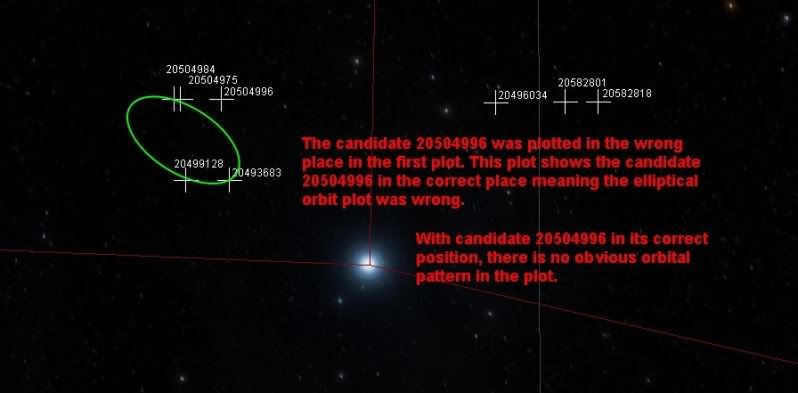 I am sorry for making this mistake, John.
ID: 928037 · |
|
Josef W. Segur Send message Joined: 30 Oct 99 Posts: 4504 Credit: 1,414,761 RAC: 0
|
... It also had, and still has, the wrong hour angle. The horizontal plot position should be the same as 20499128 since they have the same hour angle. And the distance between 20504996 and 20504975 should be almost exactly the same as that between 20504975 and 20504984. Hmm, that gets it back much closer to the original ellipse... The 20504984, 20504975, 20504996 triple is 3 healpix pixels at the same declination and about 0.042 degree separation. With the ALFA beamwidth of 0.05 degrees and uncertainty in telescope pointing of nearly the same magnitude, it's possible all three are actually the same source. Assuming they're separate and at the same distance from us, 0.042 degree separation translates to many AUs (about 2300 AU if they're around 50 lightyears from us). That's close enough that those 3 may be gravitationally interacting, but your ellipse would require a very large mass at one of the focal points. I suggest adding some scale or coordinates to any further plots. Joe ID: 928108 · |
kasule francis  Send message Joined: 9 Jul 08 Posts: 293 Credit: 104,493 RAC: 0 
|
This whole staff is complicated for me , but i think it would be good to work with google maps so they candidates are plotted by computers other than humans , after all nasa added its data bases to google earth sky. We choose to go to the moon and to do other things, we choose to go to the moon not because its easy but because its hard. kennedy ID: 928176 · |
Jon Golding  Send message Joined: 20 Apr 00 Posts: 105 Credit: 841,861 RAC: 0 
|
Maybe an updated version of the NTPCKr could include the RA/Dec error for each observation or, if these are constants, then perhaps show the region of interest on a skymap (i.e. not crosshairs). The temptation at present is to assume that the sky co-ordinates are accurate to the quoted 6 decimal places. 
ID: 928237 · |
|
Josef W. Segur Send message Joined: 30 Oct 99 Posts: 4504 Credit: 1,414,761 RAC: 0
|
Maybe an updated version of the NTPCKr could include the RA/Dec error for each observation or, if these are constants, then perhaps show the region of interest on a skymap (i.e. not crosshairs). The temptation at present is to assume that the sky co-ordinates are accurate to the quoted 6 decimal places. The coordinates are the centers of the healpix pixels and those are quadrilaterals, roughly diamond in shape. There's a reasonable confidence level that a detected signal is actually within the pixel NTPCKR chooses to represent the observation, maybe the FAQ should say what the probability is. IMO, plotting would ideally show the boundaries of the pixels and represent a candidate as a circular partially transparent colored area of 0.05 degree diameter overlaid on that grid. A background image scaled and rotated correctly, or simply star positions from the hipparcos catalog plotted as white points, might be popular. I think that would have to be a custom built program, but haven't surveyed what's available to know if it might be implemented as a plugin or similar. Joe ID: 928310 · |
zpm  Send message Joined: 25 Apr 08 Posts: 284 Credit: 1,659,024 RAC: 0
|
it warrants a second pass in my opinion.  I recommend Secunia PSI: http://secunia.com/vulnerability_scanning/personal/ Go Georgia Tech. ID: 928899 · |
skildude  Send message Joined: 4 Oct 00 Posts: 9541 Credit: 50,759,529 RAC: 60 

|
You care to transport the tapes half way around the world. clearly sending data files over the internet would be bandwidth prohibitive. 50gb wouldnt play well with the seti/berkeley network  In a rich man's house there is no place to spit but his face. Diogenes Of Sinope ID: 928950 · |
|
zpm Send message Joined: 25 Apr 08 Posts: 284 Credit: 1,659,024 RAC: 0
|
You care to transport the tapes half way around the world. clearly sending data files over the internet would be bandwidth prohibitive. 50gb wouldnt play well with the seti/berkeley network the only way this would happen is if we get a fiber to fiber line from a to b.... ID: 928960 · |
|
[AF>france>pas-de-calais]symaski62 Send message Joined: 12 Aug 05 Posts: 258 Credit: 100,548 RAC: 0 
|
***Important Notice!*** hello calcul ^^ casio fx-92 collège 2D :) 20504996 <= ERROR  @+ ^^ SETI@Home Informational message -9 result_overflow with a general handicap of 80% and it makes much d' efforts for the community and s' expimer, thank you d' to be understanding. ID: 929931 · |
|
zpm Send message Joined: 25 Apr 08 Posts: 284 Credit: 1,659,024 RAC: 0
|
and that means what in plain language please, for those of us who are not gifted with the talents of math and astro coordinate system. I recommend Secunia PSI: http://secunia.com/vulnerability_scanning/personal/ Go Georgia Tech. ID: 930679 · |

©2024 University of California
SETI@home and Astropulse are funded by grants from the National Science Foundation, NASA, and donations from SETI@home volunteers. AstroPulse is funded in part by the NSF through grant AST-0307956.